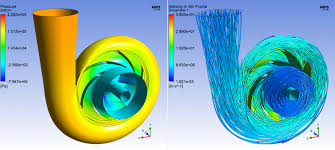
Introduction to ANSYS Fluent for Engineers
Introduction to ANSYS Fluent for Engineers
In the world of engineering simulation, ANSYS Fluent stands out as a leading computational fluid dynamics (CFD) software. It provides engineers with the tools to model fluid flow, heat transfer, and chemical reactions in complex environments. This article will introduce you to ANSYS Fluent, its capabilities, and why it is essential for engineers working in various industries.
What is ANSYS Fluent?
ANSYS Fluent is a powerful CFD software that allows engineers to simulate fluid dynamics and related phenomena with high accuracy. It is widely used in industries such as aerospace, automotive, energy, and manufacturing. The software leverages finite volume methods to solve the Navier-Stokes equations, enabling the analysis of both laminar and turbulent flows.
Key Features of ANSYS Fluent
Some of the notable features of ANSYS Fluent include:
- Robust Solver: ANSYS Fluent offers a robust solver that can handle various types of fluid flow problems, including incompressible, compressible, and multiphase flows.
- User-Friendly Interface: The software provides an intuitive graphical user interface (GUI) that allows engineers to set up simulations easily, visualize results, and perform post-processing.
- Advanced Physics Models: Engineers can utilize advanced models for turbulence, heat transfer, chemical reactions, and more, allowing for detailed analysis of complex interactions.
- Customization and Automation: ANSYS Fluent supports scripting and customization, enabling engineers to automate repetitive tasks and create tailored solutions.
- High-Performance Computing: The software can be run on high-performance computing (HPC) clusters, significantly reducing simulation times for large-scale problems.
Applications of ANSYS Fluent
ANSYS Fluent is versatile and can be applied in various engineering fields. Here are some common applications:
- Aerospace Engineering: Simulating airflow over aircraft wings, optimizing aerodynamics, and analyzing heat transfer in engine components.
- Automotive Engineering: Evaluating engine performance, exhaust systems, and thermal management within vehicles.
- Energy Sector: Modeling fluid flow in pipelines, renewable energy systems, and combustion processes in power generation.
- HVAC Systems: Designing effective heating, ventilation, and air conditioning systems by analyzing airflow and temperature distributions.
- Biomedical Engineering: Studying blood flow in medical devices and optimizing drug delivery systems.
Getting Started with ANSYS Fluent
For engineers looking to get started with ANSYS Fluent, follow these steps:
- Familiarize Yourself with the Software: Begin by exploring the user interface and understanding the basic functions. ANSYS provides extensive documentation and tutorials to help new users.
- Learn the Fundamentals of CFD: Understanding the principles of fluid dynamics and numerical methods will enhance your ability to set up and interpret simulations correctly.
- Practice with Sample Problems: Start with simple problems to build your confidence before tackling complex simulations.
- Utilize Online Resources: Take advantage of online courses, forums, and webinars to deepen your knowledge and connect with other engineers.
- Engage with the Community: Join ANSYS user groups and participate in discussions to learn best practices and gain insights from experienced users.
Conclusion
ANSYS Fluent is a critical tool for engineers seeking to model and analyze fluid dynamics and thermal processes accurately. Its powerful capabilities and user-friendly interface make it an invaluable resource across various industries. By mastering ANSYS Fluent, engineers can improve their designs, optimize processes, and ultimately drive innovation in their respective fields.